
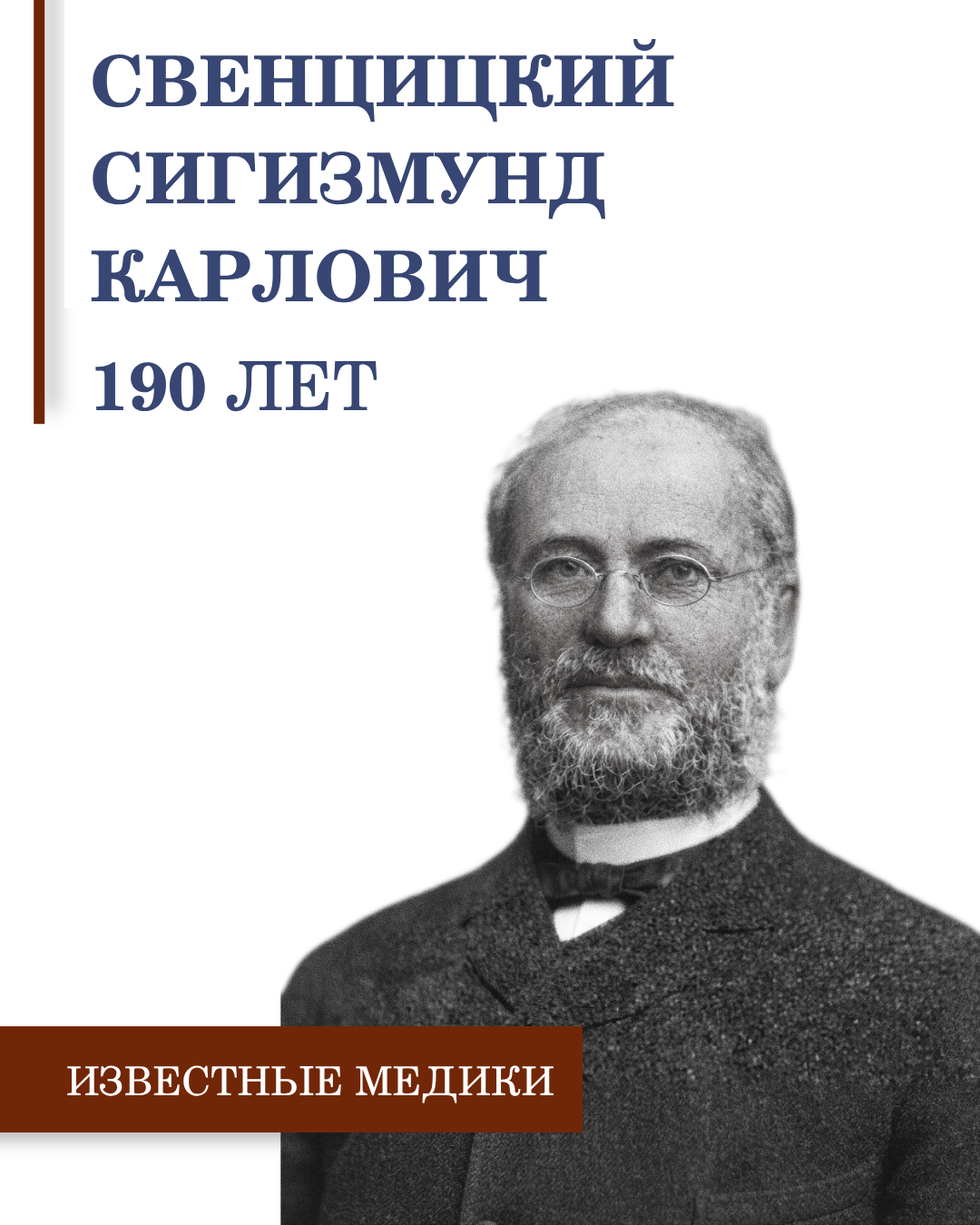
Sigismund Karlovich Sventsitsky was born in 1836 in the Kristinivi esate of the Kobrin district of the Grodno province (now Drogichinsky district of the Brest region) in the family of a poor nobleman. He received his secondary education at the Pinsk Noble School and the Minsk Gymnasium.
Sigismund was nor even 16 years old when he entered the medical faculty of Moscow University. During his studies, he took an active part in the student movement, which forced him to leave his studies and return to his homeland. On the advice of his older brother, Sigismund continued his education at the St. Petersburg Medical and Surgical Academy. At that time, the academy was the best educational institution for training doctors in the Russian Empire. Sigismund graduated from the academy in 1861 with a gold medal. The name of Sventsitsky as the best graduate was put on the marble board of the conference hall of the academy, and he himself was left to prepare for scientific and pedagogical work.
In 1860 S. Sventitsky visited his homeland in the Kobrin district, where he becane closely acquainted with the famouse writer Eliza Ozheshko. This acquaintaince was described to her in the work “First love”. There Sigismund Karlovich met his future wife Maria Mickiewicz, the niece of the famous poet Adam Mickiewicz.
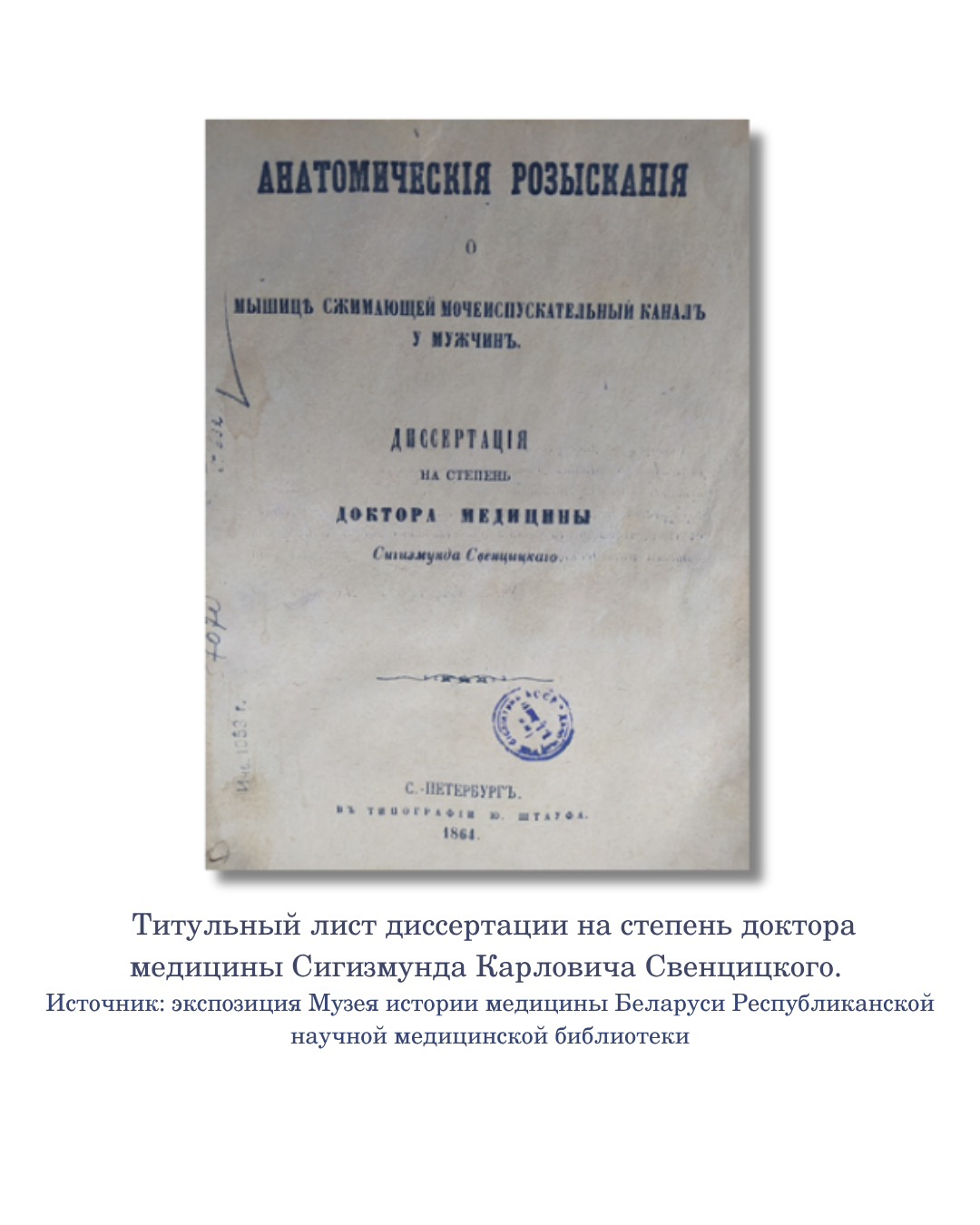
After 3 years Sigismund Karlovich brilliantly defended his doctoral thesis on the topic “Anatomical research on the muscle that compresses the uretha in men.’ It would seem that the path to a professorship will open up for him. However, fate decreed otherwise. The situation in the country afre the uprising of 1863 changed, and the doctor with his progressive views could not count on a scientific career. He had to leave the academy forever.
In 1870 , Sigismund Karlovich was appointed senior physician of the Minsk Military Hospital, and from then on, his entire life was connected with Belarus. In addition to surgery, he dealt with issues of epidemiology, therapy, dermatology, balneology, and healthcare organization. In his first year of work in Minsk, he analysed the spread of cholera in the city. He explained the development of the epidemic in Minsk by the shortcomings of public hygiene and put forward proposal for organizing disinfection as one of the most important measures against epidemic diseases. He also noted the insusceptibility of some individuals to the disease, that is, the phenomenon of immunity, thereby anticipating the emergence of immunology.
But the main merit of Professor S.K. Sventitsky lies in the organization of outpatioent care for the population. There were no polyclinics at that time, and patients were served exclusively by private practitioners who were inaccessible to the poor. Back in 1870, Sigismund Karlovich proposed to the Society of Minsk Physicians to create a free hospital and prepared its charter. However, he was able to realize his idea only nine years later. On December 18, 1879, in Minsk on Petropavlovskaya Street (now Engels Street) , the first city polyclinic, or, as it was then called, a hospital for visiting patients, was opened. Professor Sventitsky was its director and one of its consultants. In addition to him, fifteen more doctors and ten paramedics worked there. The hospital provided free qualified medical care in six specialties and also performed minor operations. Prescriptions for medicines were written on special forms of white and blue colour. According to them, city pharmacies, by prior agreement, dispensed medications at fifty percent below their cost or free of charge, depending on the colour of the prescription form.
The first Minsk polyclinic did not exist for long — in 1881 it was forced to close: “due to the refusal of the City Duma to continue the subsidy.” And only in 1899, a permanent outpatient clinic was opened with funds from the city administration.
Sigismund Karlovich Sventitsky was a consistent propagandist of advanced methods and principles of surgery, including anethesia, antiseptics, and asepsis. he improved the methods of acupressure during the enucleation of a limb at the shoudler joint, creating a new model of a clamping device. On September 28, 1874, together with I.K. Strzhalko and S.S. Shatkin, he successfelly performed such an operation. S.K. Sventitsky is considered one of the founders of intracavitary surgery in Minsk (1875), who was capable of disarticulation of large joints, plastic surgery of vesicovaginal fistula, hernia repair, and other intervention.
Sigismund Sventitsky responded vividly to various acute social and medcal problems, namely : the fight against the incidence of tuberculosis and plague, the use of new therapeutic agents, the use of local healing resources, the popularization of scientific knowledge and the exchange of scientific information, etc. He was put of the city elite; for his work for the benefit of society, the doctor received the rank of Actual State Councilor. In 1881, he was sent as a delegate from Minsk to the funeral of Alexander II. He was a member of the Scienty of Minsk Physicians in 1873 — 1885 he was the president of this society.
Having devoted much effort to organizing care in the city, S.K. Sventitsky decided to take up private practice, and from 1890 – 1908 he worked as a freelance physician, receiving patients at his home in Minsk at 36 Podgornaya Street.
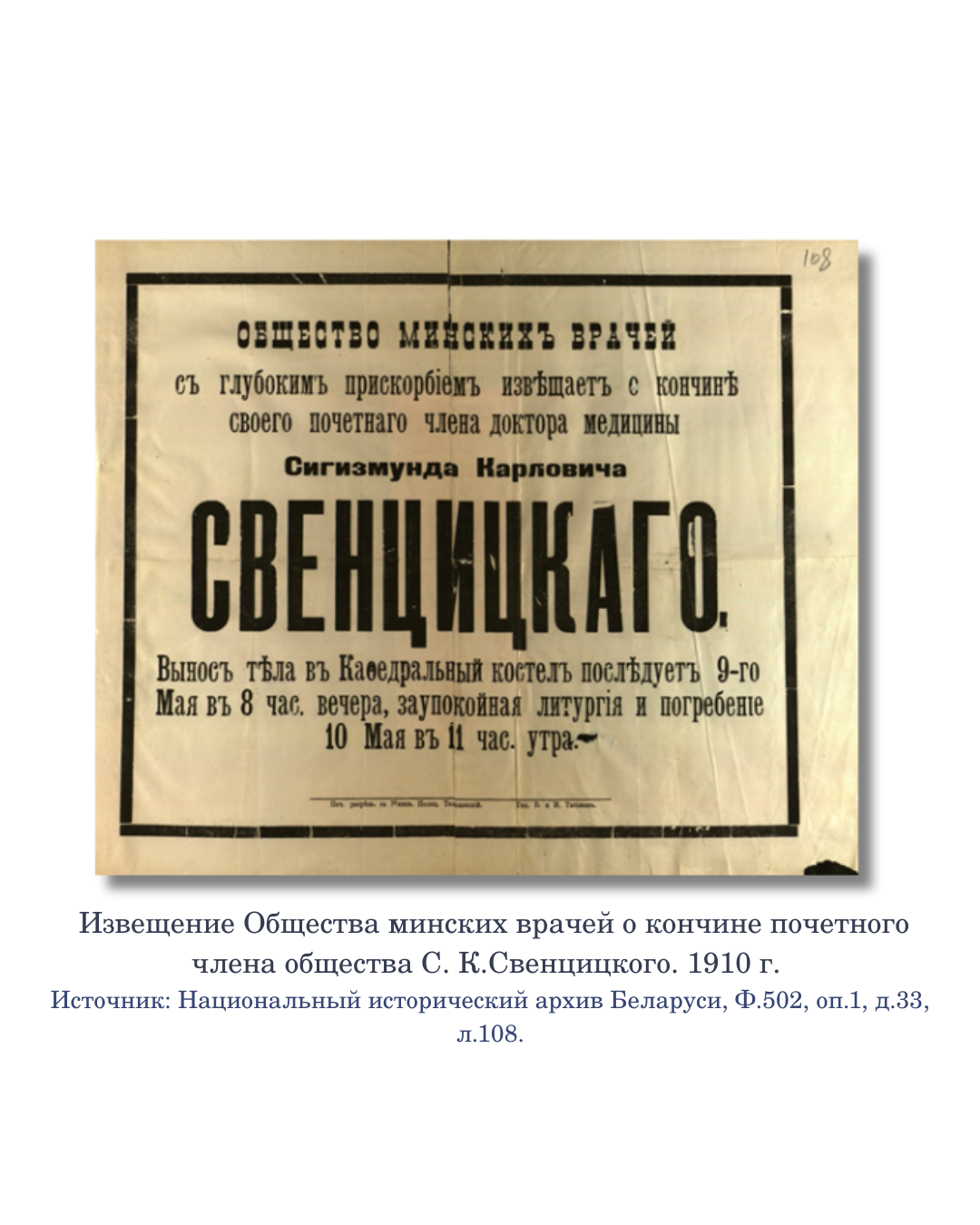
The outstanding Minsk physician, who laid the foundation of city medicine, passed away on May 21, 1910 , and was buried in Minsk at the Kalvariyskoye Cementry. In an obituary published in the journal “Minsk Medical News”, it was noted that in the person of Sigismund Sventitsky, the medical estate lost a man whose memory will long remain in all strata of our population, thanls to his outstanding works in the medical and puplic fields.
list of references:
- Крючок, Г. Р. Очерки истории медицины Белоруссии. – Мн. : Беларусь, 1976. – 264 с.
- Кульпанович, О. А. Золотой фонд медицины Беларуси. Врачи XVI – 1-й пол. ХХ в. : библиограф. справ. / О. А. Кульпанович ; науч. ред. С. П. Рубниковича. – Мн. : Колорград, 2026. – 813 с.
- [Свентицкий, Сигизмунд Карлович] : некролог // Минские врачебные известия, 1910. – № 3. – С. 26.
- Сігізмунд Карлавіч Свянціцкі // Государственное учреждение культуры «Дрогичинская районная централизованная библиотечная система». – URL: https://bibldrog.by/blog/sigizmund-karlavich-svyancicki/12/11/2020 (дата обращения: 08.10.2026).